
Prologue
The Zero-Hour Protocol:
The Panaderia Edit
The world didn't end with a bang, but
it was terrified of a ticking clock.
In the cramped room above Rosie's
Panaderia, the air was a thick,
confusing mix of cooling server fans
and the sweet, yeasty scent of
conchas rising in the ovens
downstairs. Turbo hadn't slept in
thirty-six hours. The glow of the
monitors turned the grease on the
pizza boxes into shimmering neon.
Outside, the street was alive. You
could hear the distant thump of a
block party and the occasional shout
of someone who had started their
celebration four hours too early.
They were dancing on the edge of a
digital cliff, oblivious to the
fact that the "Year 2000" wasn't
just a date, it was a deadline for
human relevance.
23:58:00
"If the BIOS trips," Turbo muttered,
his fingers hovering over a
mechanical keyboard that sounded
like gunfire in the small room,
"the backup generators at the
hospital three blocks over won't
even know they're supposed to
kick in. They'll think it's 1900
and they haven't been built yet."
The fear was simple: Two digits.
For fifty years, the world had
saved space by truncating years.
98. 99. But as the seconds bled
away on December 31, 1999, the
ghosts in the machine were waking
up.
23:59:45
I watched the cursor blink. It
ooked like a heartbeat. We
weren't just patching
COBOL; we were trying to keep the
lights on for a world that didn't
realize how thin the ice was.
23:59:59
The world held its breath. The
digits rolled over.
The silence that followed wasn't
the sound of a crash. Downstairs,
Rosie's industrial mixer hummed to
life on its automated timer, right
on schedule. The lights stayed on.
But on Turbo's secondary monitor,
the one hooked up to the
deep-packet sniffer, a line of
code scrolled past that shouldn't
have existed. The clocks hit
00:00:00. The millennium hadn't
broken the world; it had just
opened a door. And in the static
between the centuries, something,
or someone, had just stepped
through.
PLEASE CRITIQUE THIS CHAPTER AT:
solartoys@yahoo.com
IF YOU WANT TO READ THE NEXT
CHAPTER EMAIL ME:
solartoys@yahoo.com
| |||||||
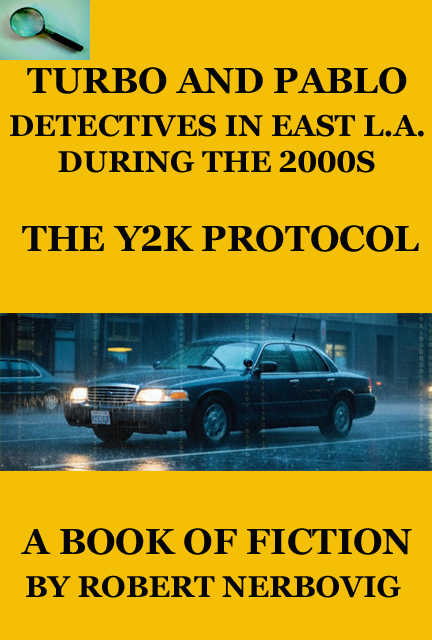
|
The new millennium didn't arrive with a bang, a digital collapse, or the celestial trumpets that the survivalists in the high desert had been predicting for years. It arrived with the smell of ozone and the steady, rhythmic clicking of a server farm located somewhere in the sub-basement of the DWP building, a sound like a thousand mechanical insects trying to chew through the city's history. I sat in the darkness of Rosie's Panaderia's upstairs office, the only light coming from the green, sickly glow of a microwave clock. I watched the numbers. They flipped from 11:59 to 12:00 without exploding. The lights didn't flicker. The 1967 Impala, parked down on 1st Street, didn't turn into a pumpkin or a pile of binary code; it remained Detroit steel, cold and indifferent to the turn of the century. "So that's it?" Pablo asked, his voice echoing in the cramped space. He was propping his feet up on the scarred wooden desk, holding a glass of tequila that cost more than the computer sitting between us. "The world was supposed to end at midnight. Planes were supposed to fall from the sky, and every bank account in the Western world was supposed to reset to zero. All I see is a quiet street and a clock that knows how to count to one. The logistics of fear are always overpriced, Turbo. They sold us a catastrophe and delivered a Tuesday." "It's not over yet, Pablo," I said, lighting a cigarette. The smoke curled around the monitor of the IBM Workstation, clinging to the glass like a gray shroud. "Y2K wasn't a hardware failure; it was a memory problem. People spent billions of dollars to fix a glitch that was just a lack of foresight by programmers who thought the 1900s would last forever. They were so worried about the date rolling over that they forgot to check the anchors. In logistics, the date is just a label on a crate. The debt, however, is permanent. It doesn't care what year the calendar says." I looked at the 1978 ledger resting on my lap. Its leather was cracked, and the edges were scorched from the fires of the previous decade, but it carried the weight of reality. While the world was busy upgrading its software, I was worried about the "Legacy Debt", the unpaid balances from 1947 that had been hidden in the folds of the city's bureaucracy. The turn of the century wasn't a reset; it was an opening. The Void, that shadow-entity that managed the city's unrecorded assets, was waiting for this exact moment of digital transition to move its heaviest pieces across the board. But then the fax machine in the corner, the one tied to the old 1978 reconciliation line, started to groan. It was a mechanical, grinding sound, the protest of a machine that had been dormant since the Reagan administration. This machine shouldn't have been working. It wasn't plugged into the new digital hub we'd installed after the mall fire. It was connected to the copper wires that ran through the foundation of the building, a legacy line that Vance, our contact in the shadow-treasury, had "forgotten" to disconnect during the 1996 audit. The paper crawled out of the machine like a slow-moving, thermal-paper tongue. It was slick, chemical-smelling, and coated in a layer of dust that had been inside the rollers for twenty years. It wasn't a standard fax; there was no header, no sender ID, and no timestamp. There was only a series of coordinates and a single line of text in a font that looked like it belonged on a 1950s punch card. THE VOID HAS BEEN RECONCILED. THE ANCHORS ARE MOVING. I picked up the paper, the heat from the thermal printer still radiating through the sheet and into my fingertips. The coordinates pointed to a specific grid in Echo Park, the exact spot where the original rail-yard strike of 1947 had been broken by the "disappearing" logistics men. This wasn't a Y2K glitch. This was a legacy audit being triggered by the turn of the century rollover. Someone, or something, was using the digital noise of the new millennium to settle a debt that had been off the books for over fifty years. "We're going to Echo Park," I said, grabbing my coat. The 1978 ledger was already tucked into my pocket, its weight reassuring against my hip. "The Y2K protocol isn't a fix, Pablo. It's a signal. The 'Void' is using the transition to move its physical assets while everyone else is distracted by their computer screens. They think the world is looking at 1s and 0s, so they're moving the real weight, the deeds, the titles, the actual soil of the city, under the cover of the glitch." Pablo stood up, his casual demeanor evaporating instantly. He knew the tone of my voice when the numbers didn't add up. He checked the cylinder of his .38, a series of mechanical clicks that sounded far more reassuring in the dark than the hum of the IBM. "If the Void is moving weight, they'll have sweepers on the ground," he warned. "Void Logistics doesn't use the DWP lines unless they're planning on erasing the footprint of whatever they touch. We're walking into a de-gaussing zone, Turbo." We headed down to the Impala. The air in East L.A. was thick with the residue of New Year's Eve fireworks, sulfur, burnt paper, and the metallic tang of spent gunpowder. The streets were eerily empty. People were huddled inside their homes, waiting for the digital sky to fall, unaware that the real threat was rolling through the tunnels and back alleys beneath their feet. I turned the key, and the 327 small-block roared to life, a physical defiance to the digital age that vibrated through the floorboards and into my bones. The drive to Echo Park was a masterclass in urban silence. The streetlights pulsed with a strange, high-frequency hum that seemed to sync with the rhythm of my own pulse. As we crossed the 4th Street Bridge, I saw the skyline of Downtown L.A., the high-rises were dark, save for the red blinking lights of the aviation beacons. The city looked like a giant circuit board that had been powered down for emergency maintenance. It was a landscape of potential energy, waiting for a spark to either restart the system or burn it to the ground. "Look at the meters," I said, nodding toward the utility poles as we slowed down near the park. The digital readouts on the new smart-meters were spinning backward at an impossible speed. "The Y2K fix didn't patch the date; it opened a back door. They're siphoning the city's residual power, the 'Dark Current', back into the old 1947 grid. They're charging up the legacy infrastructure to move something massive." We reached the lake at Echo Park just as the fog began to roll in from the coast, a thick, gray blanket that tasted of salt and industrial exhaust. In the center of the park, near the lotus beds, a group of men in gray tactical gear were unloading a series of heavy, lead-lined crates from a flatbed truck that had no license plates or markings. The crates were embossed with the same logo I'd seen on the fax: a black circle with a white line through the center. The symbol of Void Logistics, the zero that consumes everything. "Those are 1950s archival racks," I whispered, watching through the binoculars as the men worked with surgical precision. "Lead-lined to prevent data-corruption from magnetic interference. They aren't moving servers, Pablo. They're moving the 'Anchors', the physical land titles and original debt-contracts that the digital Void is built upon. If they get those to the hub, the theft of the neighborhood becomes permanent. They'll be able to delete Rosie's Panaderia from history with a single keystroke." A man stepped out from the shadows of the truck. He was wearing a tailored suit that looked thirty years out of date, but he moved with the precision of a modern operative. He held a device that looked like a hybrid of a Geiger counter and an early PDA, its screen emitting a cold, blue light. He was scanning the crates, his face illuminated by the data-stream. He looked less like a businessman and more like an undertaker for the truth. "That's the Auditor," I said, recognizing the stiff, bureaucratic posture. "He's the one who reconciles the physical world with the virtual ledger. If we stop him, the Void loses its connection to the dirt. The whole system becomes a ghost without a body. Without those crates, they have no legal standing in the physical world." Pablo moved toward the flank, his boots silent on the damp grass. "I'll draw the sweepers toward the water," he whispered, his hand hovering near his holster. "You get to the lead-line. If you can't take the crates, burn the ledger. A discrepancy in the record is better than a total loss. Make them account for the missing weight." The details of the encounter were skewed. They had the technology, the numbers, and the authority of a ghost-government that had been operating in the shadows for half a century. I had a 1967 Chevy, a book of unpaid bills from 1978, and a sense of justice that was probably a liability. But in Los Angeles, the man with the oldest records usually wins the argument, and I was carrying the oldest blood on the block. I crept toward the flatbed, the air around the crates vibrating with a low-frequency thrum that made my teeth ache and my vision swim. This was the Y2K Protocol in action: the conversion of physical weight into digital certainty. As I reached the first crate, I saw the labels. They weren't just titles; they were the original deeds for the entire Echo Park neighborhood, dated 1947, signed in the ink of men who had been dead for decades. "Hey!" a voice barked from the darkness behind me. A sweeper stepped into the light of the flatbed, his submachine gun leveled at my chest. He didn't look like a soldier; he looked like a bank guard from a future that hadn't happened yet, sterile, efficient, and completely devoid of empathy. "The audit is closed," I said, pulling the 1978 ledger from my pocket and holding it up like a badge of office. "You're operating on a legacy line, and I have the closing signature for this sector. You're trespassing on a reconciled account." The sweeper hesitated. In the world of Void Logistics, the rules of accounting are more powerful than the rules of engagement. He looked at the scorched leather of the ledger, then at the Auditor. For a split second, the numbers of the entire city hung in the balance, waiting for a decision. Then, the ground began to shake. Not the sharp jolt of an earthquake, but a rhythmic, industrial pounding from deep beneath the lake. The lotus beds parted as a massive, rusted iron pylon began to rise from the water, dripping with silt and history. It was a 1940s relay tower, hidden for decades, now reactivated by the Y2K rollover. "The anchor is surfacing!" the Auditor shouted, his voice cracking with a mixture of fear and excitement. "Reconcile the grid! Finalize the transfer before the window closes!" I didn't wait for the sweeper to make up his mind. I slammed the 1978 ledger onto the lead-lined crate, the physical contact creating a spark of static electricity that smelled of burnt paper. The reaction was instantaneous. The blue light from the Auditor's device turned a violent, angry orange, the exact color of the ink my uncle had used to record the 1947 strikes. The discrepancy hit the system like a virus, a legacy error that the modern software couldn't bypass. "Audit Conflict!" the Auditor screamed, his device emitting a high-pitched whine that sounded like a dying animal. "1978 data detected in a 2000 sequence! The chain is broken! We're losing the sync!" The sweepers scrambled, their tactical displays flickering and dying as the electromagnetic field collapsed. The iron pylon in the lake groaned, its rusted gears grinding to a halt before it could fully lock into the grid. The physical and the digital were at war, and the 1978 ledger was the front line. "Pablo! Now!" I yelled, diving behind the wheel of the flatbed. A flash-bang grenade went off near the truck, a bloom of white light that blinded the sweepers and scorched the fog. Pablo emerged from the haze, his .38 barking three times in rapid succession. He wasn't aiming for the men; he was aiming for the tires of the flatbed and the cooling vents of the lead crates. If the internal temperature of those crates rose, the magnetic anchors would fail. "Liquid nitrogen!" Pablo shouted, pointing to the leaking vents as white vapor hissed into the night air. "They're using super-cooled conductors to move the data! Break the seal and the whole thing fries in the heat of the moment!" I grabbed a heavy iron wrench from the back of the truck and smashed the primary valve on the largest crate. A cloud of white vapor erupted, instantly freezing the grass and sending a cold jolt through my arms. The Auditor fell back, shielding his eyes as the "Void" inside the crate started to boil over, the digital data evaporating into the L.A. night. The pylon in the lake shrieked one last time, a sound of metal fatigue and lost dreams, before sinking back into the silt. The amber sky faded, replaced by the dull gray light of a typical L.A. morning. The sweepers retreated into the fog, their mission compromised by a twenty-year-old book and a man who refused to forget the math. "We didn't stop them forever, did we?" Pablo asked, walking toward the truck as the sun began to rise over the horizon. He looked at the frozen crates, now covered in a layer of industrial frost that sparkled like diamonds in the early light. "We delayed the reconciliation," I said, wiping the frost from the cover of my ledger. The leather felt warm again. "We forced a 'Re-Entry.' They'll have to wait for the next major digital rollover to try this again. But now they know we have the 1978 key. The secret is out, Pablo. The audit has officially begun." The Auditor was gone, leaving behind nothing but his PDA, which was now nothing more than a melted lump of plastic and gold wire. I picked it up. It was still warm, the ghost of the data still humming faintly in the ruined circuits. "The 2000s are going to be a long decade, Pablo," I said, looking back at the dark skyline of the city. "They aren't just coming for the money anymore. They're coming for the history. They're going to try to rewrite the dirt we stand on. We're going to need more ink." We drove back to Rosie's Panaderia in silence, the Impala's engine humming a victory song. As we crossed the bridge, I saw a single black SUV watching us from the shadows of an overpass. They weren't hiding; they were observing. They were waiting for the next page of the ledger to turn. I went upstairs to the office and opened the new ledger I'd bought for the millennium. I picked up my pen and wrote the first entry of the new era: JANUARY 1, 2000. CASE #2000-001. SUBJECT: THE ECHO PARK ANCHOR. STATUS: DISPUTED. RECONCILIATION PENDING. I looked at the microwave clock. It was 4:00 AM. The world hadn't ended, but the audit had just become a war. I closed the book, the sound of the heavy cover echoing in the quiet room like a gavel in a courtroom where the judge had already fled. "Turbo," Pablo called from downstairs, his voice sounding small in the vastness of the bakery. "The fax machine is making that noise again. The groaning." I didn't go down. I knew what it was. It was the sound of the Void recalculating its debt, adjusting its algorithms to account for a man named Turbo. And I knew that by the time the sun came up, the neighborhood would look the same to everyone else, but for us, the numbers beneath it would never be the same again. 
This site is designed and maintained by: Robert Nerbovig |